Table of Contents
- Key Points
- What Are Storm Drains and Why Do They Matter?
- Types of Storm Drains: Understanding Your Options
- Comprehensive Stormwater Management Systems
- Residential Stormwater Management Systems
- Quality Materials and Installation
- The Importance of Proper Stormwater Management
- Learn More About Storm Drains and Stormwater Systems
- References
Key Points
- Stormwater systems are a vital component of any construction project.
- There is a lot that goes into storm drain planning and implementation.
- Understanding how stormwater systems work is the first step to determining how they might benefit your business or project.
When it comes to preparing a site for construction in the Upstate of SC, proper drainage systems are overlooked. Whether you are developing a commercial property, building a residential subdivision, or upgrading existing infrastructure, understanding stormwater management is essential for protecting your investment and ensuring compliance with local regulations.
At Collins Hammett Construction, we specialize in installing comprehensive utility systems and storm drains that keep properties safe, dry, and functional for decades to come. From installing utility lines to managing stormwater systems, our team is experienced in handling various utility and storm-related projects. Keep reading to learn more about these systems and how your project can benefit from our services.
What Are Storm Drains and Why Do They Matter?
Storm drains are engineered systems designed to collect and redirect rainwater, melting snow, and other surface runoff away from streets, parking lots, buildings, and other developed areas. Unlike sanitary sewers that carry wastewater to treatment facilities, storm drains transport water directly to natural water bodies like rivers, streams, and lakes.1
The importance of properly designed stormwater drainage systems cannot be overstated. Without adequate drainage, properties face many risks, including:
- Foundation damage
- Soil erosion
- Flooding
- Standing water that breeds mosquitoes
- Liability issues.
For commercial properties in particular, poor stormwater drainage can disrupt business operations, damage inventory, and create hazardous conditions for customers and employees.
In Greenville, South Carolina, where we experience significant rainfall throughout the year—averaging over 50 inches annually—effective stormwater management is absolutely essential. Our region’s terrain, with its mix of hills and developed urban areas, creates unique drainage challenges that require expert planning and execution.
Types of Storm Drains: Understanding Your Options
When designing stormwater drainage systems, it is important to understand that there are multiple types of storm drains, each serving specific purposes and suited to different applications. The right choice depends on factors like property size, terrain, local regulations, and budget constraints.
Surface Drainage Systems
Surface drainage is the most visible type of stormwater management. These systems use graded surfaces, swales, and channels to direct water flow across the ground surface to collection points. Key components include:
- Catch basins: These grated inlets are commonly seen along streets and parking lots, collecting surface water and directing it into underground pipes2
- Trench drains: Linear drainage channels covered with grates, ideal for driveways, loading docks, and areas with heavy water flow
- Channel drains: Similar to trench drains but typically used in residential applications like patios and pool decks
- Area drains: Square or rectangular grated drains placed in low-lying areas where water naturally accumulates
Subsurface Drainage Systems
These are below-ground systems that handle water that infiltrates the soil. These stormwater drains are essential for preventing soil saturation and protecting building foundations:
- French drains: Perforated pipes surrounded by gravel that collect and redirect subsurface water
- Curtain drains: Shallow trenches filled with gravel that intercept surface water before it can infiltrate
- Foundation drains: Perimeter systems installed around building footings to keep basements and crawl spaces dry
Advanced Stormwater Treatment Systems
Modern stormwater treatment systems go beyond simple collection and conveyance. These advanced solutions address water quality concerns and help meet increasingly stringent environmental regulations:
- Bioretention cells: Landscaped depressions that filter pollutants through soil and vegetation3
- Permeable pavement: Specially designed surfaces that allow water to infiltrate rather than run off
- Retention ponds: Permanent pools that treat stormwater while providing aesthetic and wildlife benefits
- Detention basins: Temporary storage areas that slowly release water to prevent downstream flooding
- Oil-water separators: Devices that remove petroleum products and other contaminants before discharge
Comprehensive Stormwater Management Systems
Effective stormwater management systems integrate multiple components to create comprehensive solutions. At Collins Hammett Construction, we do not just install drains—we engineer complete stormwater drainage systems tailored to each property’s unique characteristics and requirements.
A well-designed system typically includes:
- Collection infrastructure: Catch basins, inlets, and grates that capture surface runoff
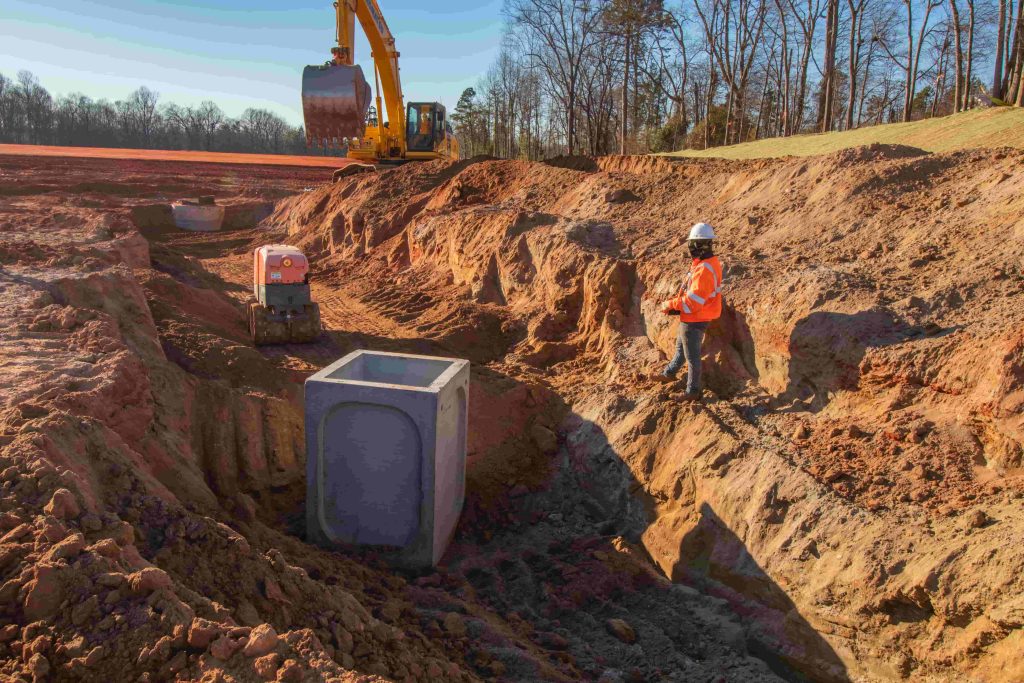
- Conveyance network: Underground pipes, culverts, and channels that transport water away from critical areas
- Storage and treatment: Retention or detention facilities that manage flow rates and improve water quality
- Discharge points: Properly designed outlets that safely return water to natural drainage ways or municipal systems
- Maintenance access: Cleanouts, manholes, and inspection ports that allow for ongoing system upkeep
The complexity of modern stormwater systems means that proper design requires both technical expertise and intimate knowledge of local conditions. Major factors we consider include:
- Soil permeability
- Groundwater levels
- Existing topography
- Future development plans
- Municipal requirement
Residential Stormwater Management Systems
While commercial and industrial projects often receive the most attention, residential stormwater management systems are equally important for protecting homes and neighborhoods. Homeowners in the Greenville area face unique challenges due to our region’s clay-heavy soils, which have poor drainage characteristics.
Common residential stormwater solutions include:
- Downspout extensions and underground drain systems: Directing roof runoff away from foundations
- Yard drains and dry wells: Managing low spots and areas of chronic standing water
- Driveway and sidewalk drainage: Preventing erosion and ice formation
- Landscape grading: Creating proper slopes to encourage water flow away from structures
- Rain gardens: Attractive, eco-friendly features that naturally filter and absorb runoff
For residential developments and subdivisions, we install comprehensive residential stormwater management systems that protect individual properties while managing neighborhood-wide drainage patterns. This often involves coordinating with local authorities to ensure compliance with ordinances and obtaining necessary permits.
Quality Materials and Installation
The longevity and reliability of stormwater systems depend heavily on material selection and installation quality. We use only proven, durable materials appropriate for each application:
- Pipe materials: HDPE, concrete, and PVC selected based on flow rates, soil conditions, and load requirements
- Grates and frames: Heavy-duty cast iron or ductile iron for traffic areas, with appropriate load ratings
- Geotextiles and filter fabrics: Preventing soil migration while allowing water passage
- Bedding and backfill: Properly graded materials that provide support and drainage
While storm drains are critical, they are just one component of comprehensive site utilities. At Collins Hammett Construction, we handle all aspects of utility installation and coordination, including water lines, sewers, and conduits.
Proper coordination between stormwater drainage and other utilities is essential. Poor planning can result in conflicts that are expensive to resolve, such as water lines crossing beneath detention ponds or electrical conduits interfering with drainage pipes.
Our installation teams are experienced in handling the unique challenges of construction projects, from working around existing utilities to dealing with difficult soil conditions. We maintain strict quality control throughout construction, conducting inspections at critical stages and performing flow testing before project completion.
The Importance of Proper Stormwater Management
Beyond protecting individual properties, effective stormwater management provides broader community and environmental benefits. Stormwater treatment systems help prevent pollutants like oil, heavy metals, sediment, and nutrients from entering local waterways. This protects aquatic ecosystems, maintains water quality in downstream areas, and helps preserve the natural beauty that makes the Upstate region such a desirable place to live and work.4
From a regulatory standpoint, municipalities are under increasing pressure to reduce stormwater pollution. This means stricter requirements for new development and, in some cases, retrofitting existing properties with improved stormwater management systems. Staying ahead of these requirements through proactive upgrades can save property owners from costly mandatory improvements down the road.
Learn More About Storm Drains and Stormwater Systems
Stormwater management may not be the most glamorous aspect of construction, but it is certainly one of the most important. Properly designed and installed stormwater drainage systems protect property values, ensure regulatory compliance, prevent environmental damage, and provide peace of mind when storms roll through the Greenville area. From basic storm drains to sophisticated stormwater treatment systems, from simple residential applications to complex commercial developments, Collins Hammett Construction has the expertise to handle your project efficiently and effectively. Contact us today to discuss your utility and stormwater drainage needs.
References
- “Understanding Storm Drains and Sewer Systems,” Rhode Island Department of Transportation, January 2017, https://dem.ri.gov/sites/g/files/xkgbur861/files/ri-stormwater-solutions/documents/2.UnderstandingStormDrains.Factsheet.pdf.
- “Catch Basins,” City of High Point, North Carolina, retrieved on December 14, 2025, from: https://www.highpointnc.gov/677/Catch-Basins.
- Albert Jarrett, Ph.D., “Rain Gardens (BioRetention Cells) – a Stormwater BMP,” Penn State University, September 2025, https://extension.psu.edu/rain-gardens-bioretention-cells-a-stormwater-bmp.
- Jason R. Masoner, Dana W Kolpin, Isabelle M. Cozzarelli, et al., “Urban Stormwater: An Overlooked Pathway of Extensive Mixed Contaminants to Surface and Groundwaters in the United States,”Environmental Science and Technology, U.S. Environmental Protection Agency, September 2020, https://pmc.ncbi.nlm.nih.gov/articles/PMC7370854/.

Thomas R. Strange III is a member at Collins Hammett Construction, LLC, located in Upstate, SC. He grew up in the grading industry, starting his career with summer and after-school jobs in 1992. In 1997, he began working full-time, running equipment for numerous projects in the area. Find him on LinkedIn.