Table of Contents
- Key Points
- What Is Land Clearing?
- What Is Dirt Moving?
- Key Differences Between Land Clearing and Dirt Moving
- Why You Need Both Services for Construction Success
- Choosing the Right Partner for Your Project
- Learn More About the Collins Hammett Advantage
- References
Key Points
- Land clearing and dirt moving are both important first steps in almost all construction projects.
- They each have different functions and goals that correspond to the foundation needs of each unique project.
- Understanding the distinct capabilities and uses of land clearing and dirt moving can help contractors and project managers understand what is best for their particular objectives.
When it comes to preparing a site for construction, the groundwork—quite literally—makes all the difference. Recent studies suggest that poor site preparation is one of the main factors in project delays.1 This can translate to serious setbacks and related financial losses.
Whether you are breaking ground on a commercial development or residential project, understanding the distinction between land clearing and dirt moving is essential to ensuring your project starts on the right foot.
As one of the best grading contractors Greenville SC has to offer, we have spent decades perfecting both disciplines. While these two services are often mentioned in the same breath, they serve distinct purposes in the construction timeline. Let’s explore what sets them apart and why both are critical to your project’s success.
What Is Land Clearing?
Land clearing is the first step in transforming raw, undeveloped property into a construction-ready site. This process involves removing all vegetation, trees, stumps, brush, rocks, and debris from the designated area.2 Think of it as creating a blank canvas—the goal is to eliminate everything that stands between the natural landscape and your construction vision.
The Land Clearing Process
When you search for “land clearing near me,” you’re looking for professionals who can handle multiple complex tasks:
- Tree and vegetation removal: Cutting down trees, removing brush, and clearing undergrowth
- Stump grinding and rock extraction: Eliminating and disposing of root systems and large rocks that could interfere with construction
- Debris removal: Hauling away all organic and inorganic materials from the site
- Topsoil preservation: When possible, saving valuable topsoil for later use3
Specialized Land Clearing Equipment
Land clearing equipment has evolved significantly over the years, allowing companies to tackle projects more efficiently and with less environmental impact. Modern land clearing services typically utilize:
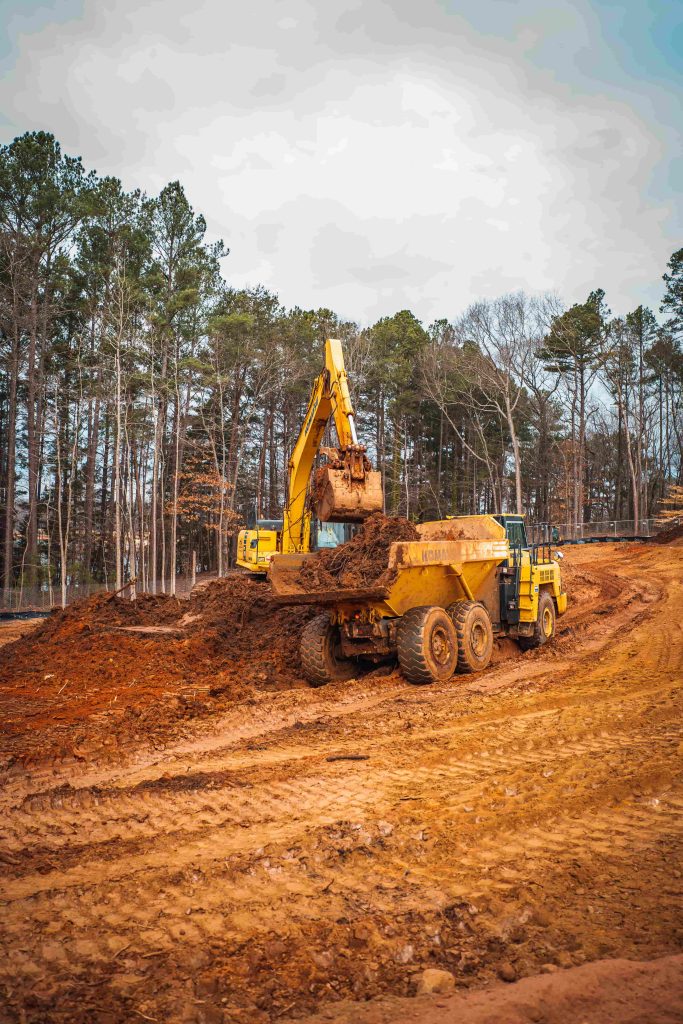
- Bulldozers: Heavy-duty machines for pushing over trees and moving large volumes of material
- Excavators: Precise equipment for digging out stumps and roots
- Forestry mulchers: Machines that grind vegetation into mulch in a single pass
- Skid steers with attachments: Versatile equipment for brush cutting and debris handling
- Dump trucks: Essential for removing cleared materials from the site
When searching for “land clearing companies near me,” it is crucial to find contractors who have modern, well-maintained equipment and employ operators who understand how to use each piece of machinery appropriately for your specific terrain and project requirements.
What Is Dirt Moving?
While land clearing focuses on removing what is on the surface, dirt moving—also known as “earthwork” or “grading”—involves reshaping the land itself. This is where we manipulate the elevation, slope, and contours of your property to create the ideal foundation for construction.
Dirt moving encompasses several critical activities:
- Excavation: Digging and removing earth to create foundations, basements, or utility trenches
- Grading: Leveling and sloping the land to ensure proper drainage and structural stability
- Cut and fill operations: Removing soil from high areas and depositing it in low areas to achieve desired elevations
- Compaction: Pressing soil to increase density and load-bearing capacity
- Trenching: Creating pathways for utilities like water, sewer, and electrical lines
Why Grading Matters
For any commercial construction project, proper grading services are non-negotiable. Here is why:
- Drainage control: Proper grading directs water away from structures, preventing flooding and foundation damage
- Structural integrity: Level, compacted ground provides a stable base for buildings and pavement
- Accessibility: Grading creates appropriate slopes for driveways, parking lots, and access roads
- Regulatory compliance: Most jurisdictions require specific grading plans to obtain building permits4
Upstate grading Greenville SC projects face unique challenges due to the region’s rolling terrain and clay-heavy soil composition. That is where experienced contractors make all the difference.
Key Differences Between Land Clearing and Dirt Moving
While both services prepare your site for construction, they differ in several important ways:
Timing in the Construction Timeline
Land clearing always comes first. You can not effectively grade land that is still covered in trees, stumps, and vegetation. Once the site is cleared, dirt-moving operations can begin. Think of it as a two-stage process:
- Remove surface obstacles (land clearing)
- Shape the earth beneath (dirt moving)
Equipment and Expertise Required
Though there is some overlap in machinery, each discipline requires specialized equipment and operator expertise. Most dirt-moving contractors will have precision grading equipment like GPS-guided dozers and laser-leveling technology—tools that are not necessary for initial clearing work.
Environmental Considerations
Land clearing requires careful attention to environmental regulations, including tree protection laws, wetland boundaries, and erosion control. Dirt moving focuses more on stormwater management, sediment control, and soil stability.5
Why You Need Both Services for Construction Success
For any construction project, attempting to skip or shortcut either service creates serious problems down the road. Here is what happens when these services are not performed or carried out improperly:
Consequences of Poor Land Clearing
- Hidden stumps and roots cause settlement and cracking in foundations
- Organic debris decomposes under structures, creating voids
- Inadequate clearing leads to drainage problems when vegetation regrows
- Construction land clearing code violations result in stop-work orders
Consequences of Inadequate Dirt Moving
- Improper drainage causes water to pool against buildings
- Insufficient compaction leads to settling and structural damage
- Wrong slopes create accessibility issues and code violations
- Erosion problems damage the property and neighboring sites
Choosing the Right Partner for Your Project
When selecting a land clearing or grading contractor, consider these factors:
Experience and Expertise
Look for contractors who understand both services and how they work together. At Collins Hammett, our integrated approach to foundation preparation ensures seamless transitions between clearing and grading phases.
Equipment and Technology
Modern land clearing equipment and precision grading technology make projects more efficient and accurate. Ask potential contractors about their equipment fleet and maintenance programs.
Licensing and Insurance
Verify that your chosen contractor carries appropriate licensing for commercial construction work, along with comprehensive liability and workers’ compensation insurance.
Local Knowledge
Land clearing and grading contractors should understand local soil conditions, drainage patterns, and municipal requirements. Upstate South Carolina’s unique geology requires specific expertise that out-of-town contractors may lack.
Environmental Stewardship
Responsible grading and land clearing services include erosion control measures, proper disposal of cleared materials, and protection of environmentally sensitive areas.
Learn More About the Collins Hammett Advantage
Understanding the difference between land clearing and dirt moving helps you make informed decisions about your construction project. Don’t let inadequate site preparation undermine your investment. Partner with experienced professionals who can guide your project from raw land to a construction-ready site.
At Collins Hammett, we are committed to providing the highest quality land clearing services and precision dirt moving that form the foundation of successful construction projects throughout the Upstate. Contact us today to discuss your site preparation needs and discover why developers and builders throughout the region trust us with their most important projects.
References
- Kwame B. O. Amoah, George Okere, and Abhijeet Deshpande, “Construction Delay Analysis: Causes, Impacts, and Mitigation Strategies,” Journal of Civil Engineering Research, December 2024, http://article.sapub.org/10.5923.j.jce.20241401.01.html.
- “Land Clearing (Ac.) (460) Conservation Practice,” National Resources Conservation Service, U.S. Department of Agriculture, retrieved on October 30, 2025, from: Shttps://www.nrcs.usda.gov/resources/guides-and-instructions/land-clearing-ac-460-conservation-practice-standard.
- Gunther Liebhard, Maron Toth, Christine Stumpp, et al., “Developing topsoil structure through conservation management to protect subsoil from compaction,” Soil and Tillage Research, November 2025, https://www.sciencedirect.com/science/article/pii/S0167198725002235.
- “Permits & Forms,” City of Greenville, South Carolina, retrieved on October 30, 2025, from: https://www.greenvillesc.gov/451/Permits-Forms.
- “Stormwater Regulations,” SC Department of Environment Services, retrieved on October 29, 2025, from: https://des.sc.gov/programs/bureau-water/stormwater/stormwater-regulations.

Thomas R. Strange III is a member at Collins Hammett Construction, LLC, located in Upstate, SC. He grew up in the grading industry, starting his career with summer and after-school jobs in 1992. In 1997, he began working full-time, running equipment for numerous projects in the area. Find him on LinkedIn.