Table of Contents
- Key Points
- Why Professional Demolition Is Essential to Commercial Development
- Structure Demolition: Complete Teardown for Commercial and Industrial Sites
- Concrete and Asphalt Removal: Clearing Hardscape for Redevelopment
- From Demolition to Development: Coordinating Site Preparation
- Serving Commercial Development Throughout Upstate South Carolina
- Frequently Asked Questions
- References
Key Points
- Professional commercial demolition requires licensed contractors, specialized equipment, and rigorous adherence to safety, environmental, and permitting requirements before any structural work begins.
- Collins Hammett Construction provides comprehensive demolition services throughout Upstate South Carolina, including complete structure teardown, concrete removal, and asphalt clearing for commercial and industrial sites.
- Demolition is the foundational step in commercial site preparation, connecting directly to grading, earth moving, and other construction activities that establish the conditions necessary for new development.
When a commercial property reaches the end of its productive life or a development site requires clearing for new construction, professional demolition becomes an essential first step in the building process. Far from a straightforward act of tearing down walls, commercial demolition entails a complex series of coordinated activities—from regulatory compliance and hazardous material assessment to structural dismantlement and debris management—that demand both technical expertise and a commitment to site safety.
Collins Hammett Construction provides comprehensive demolition services to property owners, developers, and project managers throughout Upstate South Carolina, serving Anderson, Laurens, Pickens, Greenville, and Spartanburg Counties. With experience across a wide range of commercial and industrial project types, our team delivers safe, efficient demolition services that keep commercial construction projects on schedule.
Why Professional Demolition Is Essential to Commercial Development
Commercial demolition is a regulated activity governed by federal, state, and local requirements related to worker safety, environmental protection, and structural integrity.1 Approaching it without proper planning and licensing introduces serious risk, including structural collapse, environmental penalties, costly project delays, and significant liability exposure for property owners. For developers and property owners who require demolition, working with an experienced demolition contractor is not simply a matter of convenience but a prerequisite for safe, code-compliant site preparation.
A professionally executed demolition project will involve several critical planning and compliance components:
- Structural assessment: Evaluating the composition, condition, and load-bearing characteristics of the existing structure before any work begins, including an inventory of primary materials such as concrete, steel, masonry, and wood framing.
- Hazardous material screening: Identifying and addressing regulated substance—such as asbestos, lead-based paint, and mold—that require specialized remediation prior to structural demolition.
- Permitting and regulatory coordination: Securing the required demolition permits from local building departments and adhering to OSHA standards and South Carolina environmental regulations throughout the project.2
- Neighbor and site protection: Implementing dust suppression measures, temporary fencing, and safety barriers to protect adjacent properties and maintain a secure job site.
- Debris management planning: Coordinating the removal, recycling, and proper disposal of demolition materials in compliance with applicable waste management requirements.
Each of these components requires advanced coordination and qualified professional oversight. When any one element is overlooked, the consequences can reverberate through downstream construction phases and potentially increase overall project costs.
Structure Demolition: Complete Teardown for Commercial and Industrial Sites
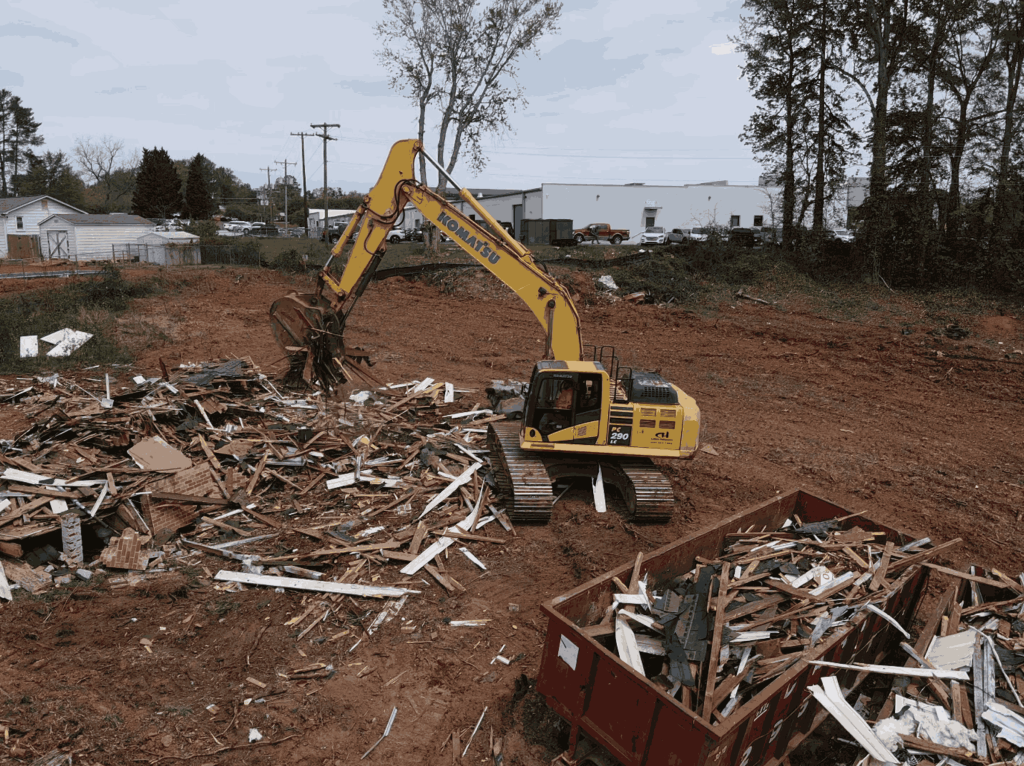
For projects requiring the full removal of an existing building or facility, Collins Hammett’s demolition contractors bring a systematic, safety-focused approach to structural teardown. Our team has experience dismantling a broad range of commercial and industrial structures, including office buildings, retail centers, warehouses, manufacturing facilities, and other non-residential construction composed of concrete, steel, masonry, and wood framing.
The demolition process typically begins with selective interior demolition—commonly referred to as soft stripping—during which interior fixtures, mechanical and electrical systems, and non-load-bearing elements are carefully removed before structural work begins. This preliminary phase reduces the volume of mixed debris generated during structural teardown and creates opportunities to salvage or recycle materials that retain residual value.3
Once interior preparation is complete, structural dismantlement proceeds using appropriate equipment and sequencing for the specific building type. Steel-framed structures, tilt-wall concrete buildings, and masonry construction each present unique challenges and require different demolition approaches and machinery. Throughout every phase, Collins Hammett manages debris removal and site cleanup, leaving the property in a clear, safe condition, and ready for the next stage of development.
Concrete and Asphalt Removal: Clearing Hardscape for Redevelopment
Many commercial redevelopment projects require the removal of existing hardscape infrastructure before new construction can begin. Concrete foundations, slabs, parking lots, curb and gutter systems, and asphalt paving represent substantial volumes of material that must be broken apart, hauled away, and properly managed before grading and new construction can proceed.
Collins Hammett’s demolition team handles the full scope of concrete and asphalt removal, from initial mechanical breakup (using hydraulic breakers and excavators) to material hauling and final site cleanup. Where feasible, removed materials are processed for recycling. Crushed concrete, for example, can often be recycled and repurposed as road base or structural fill material, reducing the volume of debris directed to landfills and contributing to more sustainable project outcomes.
Following hardscape removal, the cleared site is assessed and prepared for the grading and earthwork activities, like establishing proper drainage patterns, finished elevations, and subgrade conditions.
From Demolition to Development: Coordinating Site Preparation
As mentioned, demolition is the beginning of a broader site preparation sequence. Once existing structures and hardscape have been removed, a commercial development site typically requires a series of coordinated earthwork and infrastructure activities before vertical construction can begin:
- Rough grading: Establishing preliminary elevations and slope configurations to facilitate drainage and support subsequent fine grading operations.
- Utility disconnection and abandonment: Coordinating with utility providers to properly cap, disconnect, or relocate underground infrastructure as required by the development plan.
- Soil assessment and stabilization: Conducting geotechnical evaluation of subgrade conditions and implementing any necessary soil treatments to achieve appropriate bearing capacity for new construction.
- Erosion and sediment control: Installing silt fences, erosion blankets, and other best management practices to protect neighboring properties and waterways throughout the transition from demolition to active construction.
When a single, experienced contractor manages both demolition and subsequent site preparation activities, project owners benefit from improved scheduling coordination, clearer lines of accountability, and fewer handoff delays between project phases.
Serving Commercial Development Throughout Upstate South Carolina
Upstate South Carolina continues to attract significant commercial and industrial investment, and the pace of new development and redevelopment activity across the region reflects sustained demand for qualified site preparation contractors. Collins Hammett Construction meets this demand through a combination of technical capability, regional knowledge, and a commitment to safety and professionalism on every project.
Our service area includes Anderson, Laurens, Pickens, Greenville, and Spartanburg Counties, and our team is thoroughly familiar with the regulatory requirements, local permitting processes, and terrain characteristics that shape commercial development projects throughout the region. Reach out to us today to learn more about our demolition services.
Frequently Asked Questions
What types of commercial structures does Collins Hammett demolish?
Collins Hammett handles the demolition of a wide range of commercial and industrial structures, including office buildings, retail centers, warehouses, manufacturing facilities, and other non-residential buildings. Our contractors are experienced with concrete, steel, masonry, and wood-framed construction of varying sizes and complexities.
Does Collins Hammett handle debris removal and site cleanup after demolition?
Yes. Debris removal and site cleanup are included as part of our demolition services. Where feasible, demolition materials are processed for recycling rather than directed to a landfill, and the site is left in a clean, cleared condition ready for subsequent grading or construction activities.
What permits are typically required for commercial demolition in South Carolina?
Permitting requirements vary by municipality and project scope, but most commercial demolition projects require a demolition permit from the local building department. Projects involving asbestos or other regulated materials may require additional notifications or environmental clearances. Collins Hammett coordinates all permitting requirements as part of the project planning process to ensure all regulatory obligations are met before demolition begins.
References
- “Renovations and Demolitions,” South Carolina Department of Environmental Services, retrieved on June 15, 2026, from: https://des.sc.gov/programs/bureau-air-quality/asbestos/renovations-and-demolitions
- “Demolition,” Occupational Safety and Health Administration, U.S. Department of Labor, retrieved on June 16, 2026, from: https://www.osha.gov/demolition/standards.
- Anthony Davis, “The advantages of professional soft strip demolition,” Highways Today, April 2018, https://highways.today/2018/04/30/advantages-professional-soft-strip-demolition/

Thomas R. Strange III is a member at Collins Hammett Construction, LLC, located in Upstate, SC. He grew up in the grading industry, starting his career with summer and after-school jobs in 1992. In 1997, he began working full-time, running equipment for numerous projects in the area. Find him on LinkedIn.