Table of Contents
- Key Points
- What Is 811?
- Why Calling 811 Matters for Construction and Grading Projects
- The 811 Process: Step by Step
- How Collins Hammett Construction Approaches 811 Compliance
- Frequently Asked Questions
- References
Key Points
- Calling 811 at least three full business days before any excavation is a legal requirement in South Carolina and the single most important step for preventing catastrophic utility strikes during construction.
- Understanding what 811 is and how the request process works helps contractors, property owners, and developers avoid project delays, costly fines, and serious safety hazards.
- Professional grading contractors build the 811 notification process into every project timeline to protect workers, infrastructure, and the surrounding community.
There are 20 million miles of underground utility lines in the United States. According to the Common Ground Alliance, about 40 million Americans put themselves and their property at risk by undertaking digging projects without taking the proper precautions.1 Underground utility lines get struck hundreds of thousands of times annually during excavation and construction activities. Many of these incidents are entirely preventable.
For property owners, developers, and contractors working in the Upstate region, understanding the 811 process is not simply a “best practice” but a legal obligation. South Carolina law requires anyone planning to dig to contact 811 before excavation begins, and failure to comply can result in significant financial and legal consequences.2
At Collins Hammett Construction, the 811 notification is a foundational part of every project we undertake, from construction land clearing operations to grading, utility installation, and commercial site development.
What Is 811?
The number 811 is a federally designated, toll-free “Call Before You Dig” hotline that connects excavators and property owners with their state’s one-call notification center.3 In South Carolina, the one-call center is known as South Carolina 811 (formerly Palmetto Utility Protection Service, or PUPS).
When you call 811, the center notifies all member utility companies that have underground infrastructure in the area of the proposed excavation. Those utility operators are then responsible for sending locators to the site to mark the approximate location of their buried lines using color-coded paint, flags, or stakes.
The types of underground utilities that may be marked include:
- Red: Electric power lines and cables
- Yellow: Natural gas, oil, steam, and petroleum lines
- Orange: Telecommunications, alarm, signal, and cable TV lines
- Blue: Potable (drinking) water lines
- Green: Sewer and storm drain lines
- Purple: Reclaimed water, irrigation, and slurry lines
- White: Proposed excavation boundaries (marked by the excavator)
This color-coded system is standardized nationally by the American Public Works Association (APWA) and ensures that every crew member on a jobsite can quickly identify what lies beneath the surface.4
Why Calling 811 Matters for Construction and Grading Projects
Underground utility strikes can cause gas leaks, electrical fires, water main breaks, sewage spills, and widespread service outages. These incidents endanger workers, damage critical infrastructure, and can halt a project for days or even weeks.
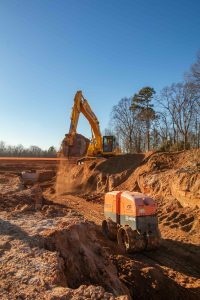
The stakes are particularly high for grading and earthmoving operations, where heavy equipment routinely excavates to depths of several feet or more. Bulldozers, excavators, and motor graders can sever a buried gas line or fiber optic cable in seconds, and the consequences can be severe. In the worst cases, utility strikes have resulted in explosions, serious injuries, and fatalities.
Beyond the immediate safety risks, striking an unmarked or improperly identified utility line can expose a contractor to significant liability. Repair costs for damaged infrastructure can range from thousands to hundreds of thousands of dollars, depending on the utility involved. Projects may face stop-work orders, regulatory investigations, and legal action from affected utility providers and neighboring property owners.
In addition to state-level penalties, federal regulations under the Pipeline and Hazardous Materials Safety Administration (PHMSA) impose additional requirements and potential fines for damage to natural gas and hazardous liquid pipelines. For companies involved in commercial construction, a single utility strike can result in project delays, increased insurance premiums, reputational harm, and exclusion from future bidding opportunities.5
Professional contractors understand these risks and treat the 811 process as a non-negotiable first step. At Collins Hammett Construction, we submit locate requests well in advance of any scheduled excavation, verify that all markings are in place before equipment mobilizes, and maintain clear communication with utility locators throughout the project.
The 811 Process: Step by Step
The process for reporting planned digging to 811 is straightforward. South Carolina law requires that the request be made at least three full business days (excluding weekends and legal holidays) before excavation begins. Here is how it works:
- Submit the request: Contact 811 by phone or submit a request online through the South Carolina 811 website. Provide the location of the planned excavation, the type of work being performed, and the expected start date.
- Wait for locators: After the request is filed, relevant utility companies are notified, and they dispatch locators to mark their respective underground lines. Locators have two full business days to complete their markings.
- Verify and respect the markings: Before digging, confirm that all utilities have been marked or that a “clear” notification has been received for each utility type. Maintain a tolerance zone of at least 24 inches on either side of all marked lines, within which hand digging or other non-mechanized methods must be used.
- Maintain the marks: If markings become faded, disturbed, or obscured during the course of work, request a re-mark before continuing excavation in the affected area.
For large-scale construction projects, locate requests may need to be submitted in stages as work progresses across the site. Keeping the 811 process integrated into the project schedule helps prevent delays and ensures continuous compliance.
How Collins Hammett Construction Approaches 811 Compliance
As a full-service site preparation and construction contractor, Collins Hammett handles 811 coordination as a core component of project planning. Our team submits locate requests before any equipment arrives on site, verifies utility markings against project plans, and coordinates directly with utility providers when conflicts or discrepancies arise.
This proactive approach protects our crews, our clients, and the communities where we work. Whether the project involves rough grading for a new commercial pad, utility trenching, or full-scale land clearing, proper 811 compliance is always the first order of business.
Contact us today to learn more about our standards, processes, or to discuss your Upstate construction project.
Frequently Asked Questions
How far down can I dig before calling 811?
There is no minimum depth threshold. South Carolina law requires that you call 811 before any excavation, regardless of how shallow or deep the planned dig may be. Many utility lines, including fiber optic cables, irrigation lines, and even some gas and electric lines, are buried at relatively shallow depths—sometimes as little as 12 to 18 inches below the surface. Even minor landscaping, fence post installation, or shallow trenching can damage a buried utility if the proper locate process has not been completed.
What happens if you don’t call 811 before you dig?
If you fail to call 811 before you dig and you strike an underground utility line, you may be held legally and financially liable for all resulting damages. This includes the cost of repairing the damaged infrastructure, emergency response expenses, service restoration, and any property damage or injuries caused by the incident. In South Carolina, the penalty for digging without calling 811 can also include civil fines and—in egregious cases—criminal prosecution. Beyond legal consequences, an unreported excavation that results in a gas leak or electrical contact poses a direct threat to worker safety and public health.
References
- “Survey reveals nearly 40 percent of homeowners who plan to dig this year will put themselves and others at risk by not calling 811 before starting,” Common Ground Alliance, April 2018, https://commongroundalliance.com/Publications-Media/Press-Releases/survey-reveals-nearly-40-percent-of-homeowners-who-plan-to-dig-this-year-will-put-themselves-and-others-at-risk-by-not-calling-811-before-starting-3.
- “Ensure Your Safety and Protect Our Infrastructure,” South Carolina 811, retrieved on May 13, 2026, from: https://sc811.com/about/enforcement/.
- “FCC Designates 811 as Nationwide Number to Protect Pipelines, Utilities from Excavation Damage,” Federal Communications Commission, retrieved on May 13, 2026, from: https://www.fcc.gov/document/fcc-designates-811-nationwide-number-protect-pipelines-utilities.
- “Uniform Color Code,” American Public Works Association, retrieved on May 13, 2026, from: https://www.apwa.org/wp-content/uploads/Uniform-Color-Code-1.pdf.
- “Advancing the Safe Transportation of Energy and Hazardous Materials,” Pipeline and Hazardous Materials Safety Administration, U.S. Department of Transportation, retrieved on May 13, 2026, from: https://www.phmsa.dot.gov/.

Thomas R. Strange III is a member at Collins Hammett Construction, LLC, located in Upstate, SC. He grew up in the grading industry, starting his career with summer and after-school jobs in 1992. In 1997, he began working full-time, running equipment for numerous projects in the area. Find him on LinkedIn.